
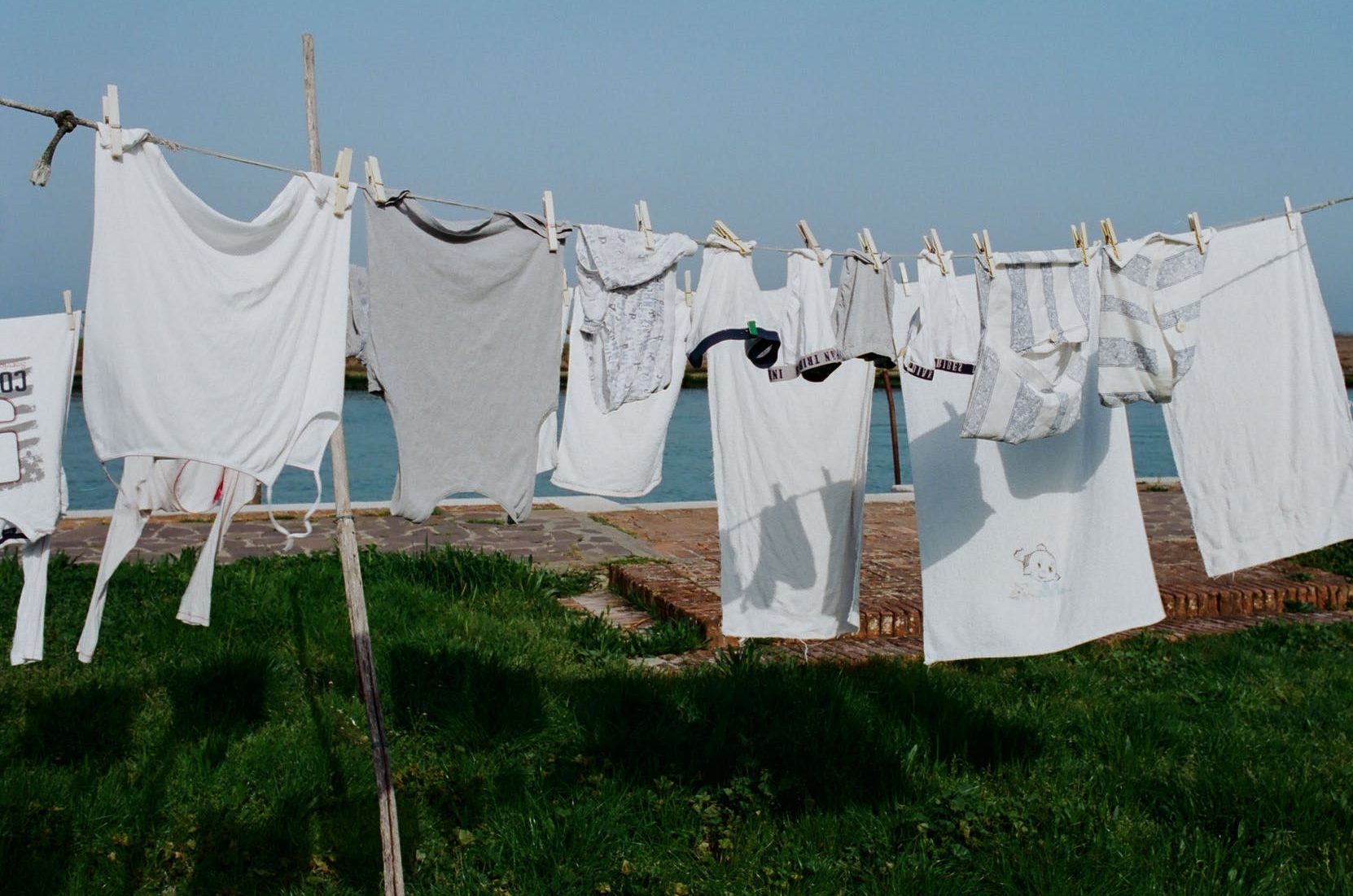
I’ve wanted to try this idea I had for an easy, affordable RV laundry hack for ages. Since it works while you travel, I decided to try this hack on my RV adventure across Saskatchewan this week. I have to admit I have never been this excited to do laundry. The initial experiment resulted in a load of dirty laundry getting clean, with hardly any effort on my part, no electricity, no laundromat, and no laundry machines.
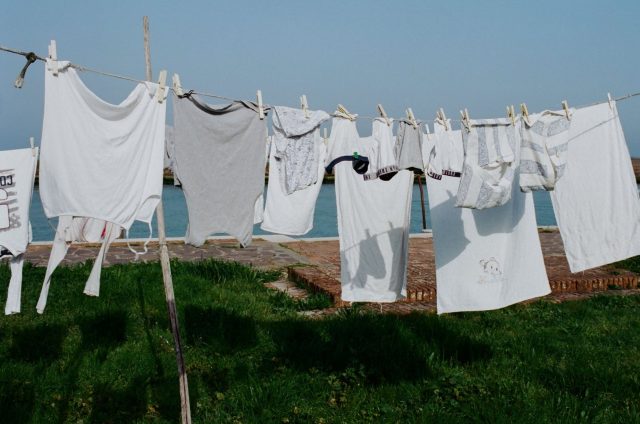
RV laundry just got really easy
RV laundry has always been a bit of a hassle. An active life of travelling, dog life, and camping make dirty laundry add up fast. Many RV manufactures and RV parks have come up with solutions like laundry centres in larger RVs and laundromats at RV parks. Those of us with smaller RV’s and tow vehicles can now choose from a few different RV washing machines, but these take up precious space and add significant weight to our rigs.
This RV laundry solution is simple, energy efficient and very effective for cleaning clothes. Dirty laundry, laundry detergent and water are added to an ordinary 5 gallon bucket. The lid is sealed tight and the bucket is secured at the back of the vehicle where there is more vibration from the road. Every bump in the road acts as agitation for this simple laundry machine, working the dirt and bad smells out of your clothes just as well as any really good washing machine. When you get to your destination, all you need to do is rinse, wring and hang your spotlessly clean clothes up to dry. I love this, because it is so environmentally friendly!
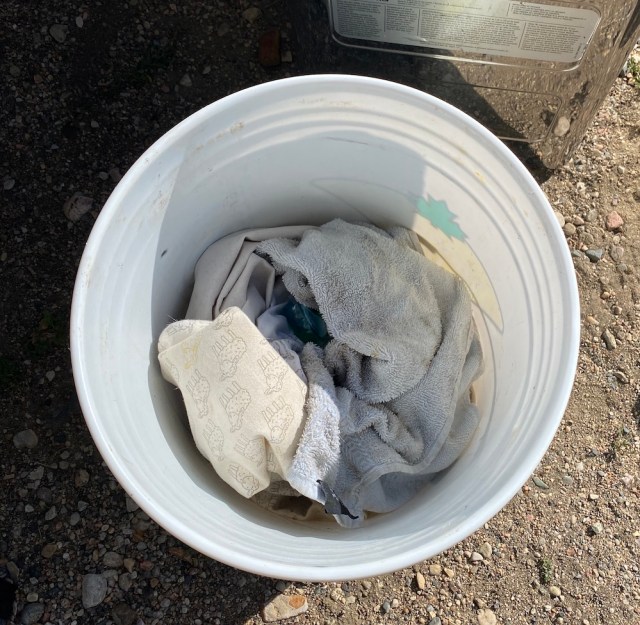
RV Laundry Hack Step #1: Gather your suppies
All you’ll need is a 5 gallon bucket with a tight fitting lid, a little laundry detergent, water and a good stretch of highway. I used a Tide pod, but you could use a small amount of any laundry detergent you like. Put a few items of dirty laundry in the bucket and add your choice of detergent. My small load had yoga pants, a t-shirt, a small towel and a really filthy dog bed cover.
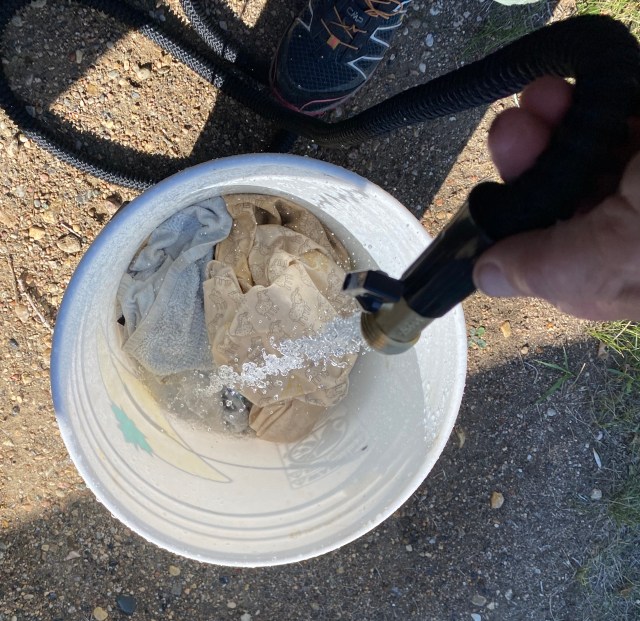
RV Laundry Hack Step #2 : Just add water
Next, cover your laundry laundry with water, plus a good few inches. As a guide, I used about 2.5 gallons of water for my small load..
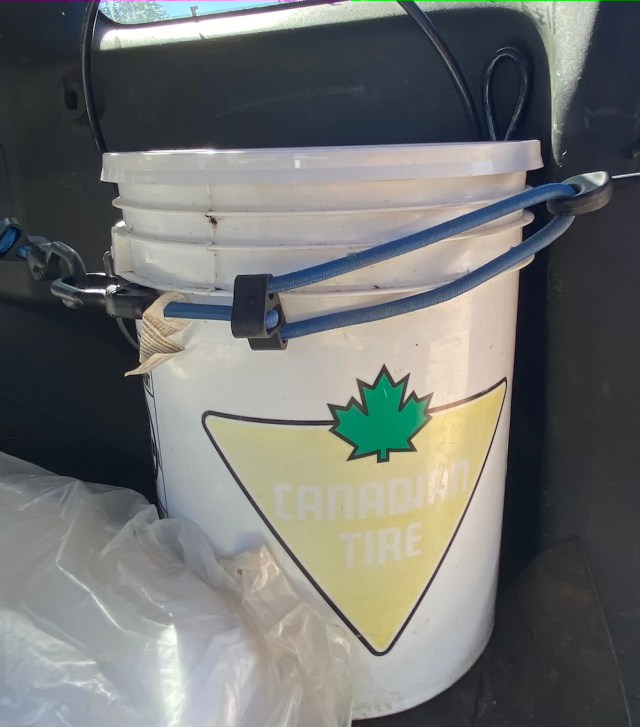
RV Laundry Hack Step #3: Seal and Secure
Seal the bucket tight with a 5 gallon bucket lid. You could probably choose to leave it unsecured, and it will “probably” stay put because of its weight. I didn’t want to risk it tipping and rolling around so just in case, I tied it into the back of my XTerra, Luckily, I have lots of spots in my vehicle to secure my bucket with bungies, so it seemed to be the best option for me.
RV Laundry Hack Step #4: Drive for a few hours
Every little bump in the road, railway track or speed bump you drive over will agitate your laundry. The agitation with help of the laundry soap will make it super clean. Saskatchewan Highways used to be better for this, but this year, but the province has done a great job resurfacing them. Alberta’s highways seem to be the roughest I’ve seen anywhere (Premier Jason Kenney are you reading this?).
Today I drove for 4 hours from Rosetown, Saskatchewan to Craik Saskatchewan, where I set up camp. I set up my laundry bucket and drove. When I got my new campsite set up at Craik Regional Park, it was time to rinse and hang my load of laundry. I was really happy with the results. Even the dog bedding looks and smells fresh and clean.
Share this:

It began like this…
“Wild women are an unexplainable spark of life. They ooze freedom and seek awareness, they belong to nobody but themselves yet give a piece of who they are to everyone they meet.
If you have met one, hold on to her, she’ll allow you into her chaos but she’ll also show you her magic.”
― Nikki Rowe
It began like this:
I have trained thousands of dogs on the West Coast of British Columbia for the past 25 amazing and wonderful years. There is absolutely nothing in the world I would have rather done for those years. I was a firefighter and first responder on our local fire department for nearly 7 years. I have a performing trick dog team, and until this last summer we performed at events on Vancouver Island. I played and I worked and I found myself surrounded with the best of the best people. There was nothing not to love about my life.
Last year I bought myself a little travel trailer, a Forest River R-Pod 180. My travel trailer is just 20 feet long. It’s tiny but perfectly well appointed for a single woman and her 4 canine compadres. Full bathroom, full kitchen, a bed a table, a couch, heat, air-conditioning, an amazing sound system, lots of storage and a very nice awning. I quickly christened my Pod “The ArfPod”.
For the first year I had it, the Arfpod rarely left my farm. Mostly because steeply rising costs of everything in BC, not the least of which is fuel, made it impossible to take time off work to go anywhere, let alone take a camping or road trip. So I made do, like we do in BC. I went “glamping” on my own beautiful property with my 4 dogs, just to see if I could do it and retain a modicum of sanity. “Why ever leave this beautiful place anyway?”, I thought.
Well then the reason to leave such a beautiful place landed. Approximately in the middle of Alberta. His name is George, and he is my grandson and George is the apple of my eye. Like his father before him, George makes my heart absolutely sing. So that was it. That was the only reason I needed to leave the magic of the rainforests. After all, real magic is carried in our hearts and exists exactly wherever we choose to believe it exists. Am I right?
So I packed up, sold the farm, and now I am headed back to a province I swore I would never return to. Not directly though. It’s winter time. Winter in Alberta is something I would like to have the opportunity to adjust to slowly, as I watch the maples and poplar trees change their colours and shed their leaves. I really don’t want to be suddenly plunged into winter’s hard frozen whiteness. And the Mid November timing of my farm sale was not conducive to finding a perfect property to live on, where my dogs and I could run, train and play because everything is under ice in Central Alberta in Mid November. And besides travelling through the mountain passes towing the Arfpod seemed…well…possibly suicidal. So what would I do?
Through my work I meet amazing people, one is my friend, an accomplished senior Dr. who invited my to camp in the Arfpod on her property on the ocean. I could stay in the Arfpod, and look after her dogs when she needed. It was a perfect opportunity and I graciously accepted her invite last week. I arrived here yesterday and this is the beginning of surely the greatest journey of my life. I hope you enjoy the tales of my Podyssey.

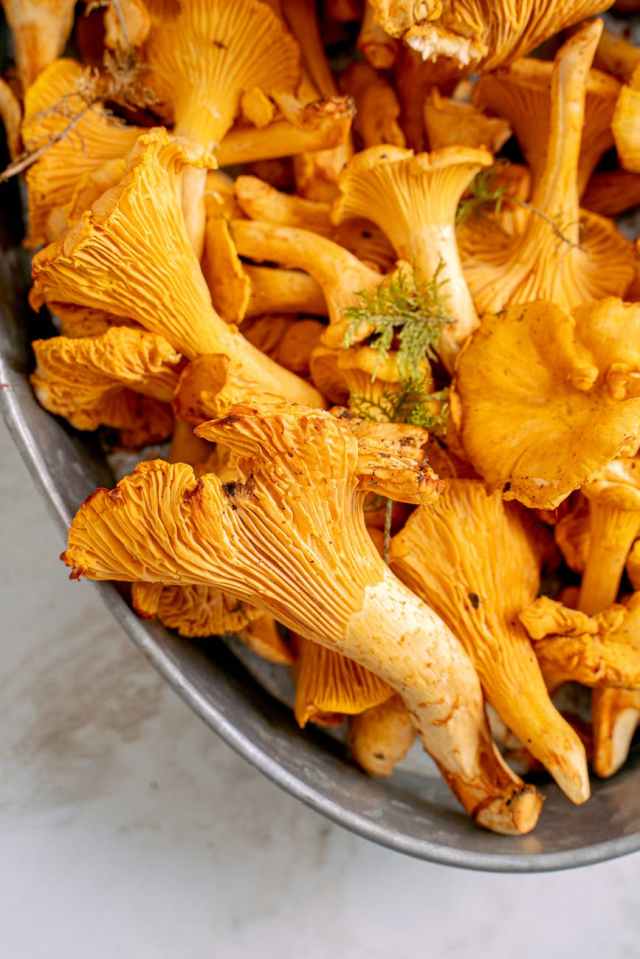
Chanterelle mushroom season is upon us here on Vancouver Island. That means I am taking my travelling companions into the forest to reap this golden chanterelle bounty. If you need help identifying chanterelles, click here for a great article. You should always double check with someone in the know if you aren’t 100% sure. You can always take a few into a mushroom buyer and ask them to confirm for you. Better to be safe than sorry!
Pro mushroom picking tip #1 : Always cut, never pull.
When you pick chanterelle mushroomss, it’s really important to cut the stems carefully, rather than just pulling them up. The chanterelle mushroom is the flowering part of the fungus, and it’s mycelia, the largest part of the mushroom is underground. This is probably why you will nearly always find chanterelle mushrooms in rafts across the forest floor. By cutting the stem instead of pulling the flower part of mushroom out of the ground, you don’t disturb the mycelia at all. This might mean more mushrooms later in the season or next year. Cutting the chanterelles also helps to keep your harvest cleaner, so it’s less work when you are cleaning them.
Pro mushroom picking tip #2: Use a soft brush to clean
No matter how carefully I cut the stems on my mushrooms, they always have some detritus from the forest loam on them. So when I get them home, I dry brush them with a soft brush, and then carefully wash any remaining dirt off.
While I often dry fry Chanterelles before cooking them in vegan butter, I wanted to try something different with the motherload I picked today.
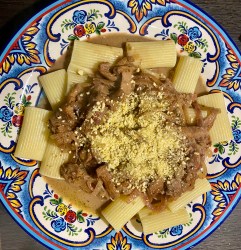
This delicious, vegan Chanterelle Mushroom Pasta was a little experiment I did that turned out to be an amazing sauce that will go with your favourite pasta.
Although I used fresh chanterelle mushrooms, there is probably no reason you couldn’t use dried mushrooms in this recipe instead of fresh chanterelles.Also, if I had white wine on hand, I would have used it instead of Shiraz, and perhaps enjoyed the lovely golden colour that help to make golden chanterelle mushrooms so appealing.
Chanterelle Pasta Sauce

Equipment
- instant pot for sauteeing
Ingredients
- 1/4 cup Becel vegan butter
- 1 Tbsp extra virgin olive oil
- 1 red oinion Medium, quartered and sliced very thin
- 2 cloves crushed garlic
- 1/4 cup red wine SHiraz or whatever you have
- 1 1/2 lbs Fresh Chanterelle Mushrooms
- 1/4 cup Nutritional Yeast
- 1 tbsp Italian spice mix Find this in the spice aisle at the grocery store
- 1 tbsp lemon Juice
- 1 pinch salt
- 1 pinch black pepper
- 1/4 cup oat milk
Instructions
- Turn your Instant Pot on to the Saute function and wait for the beep to tell you it's hot.
- Melt vegan butter in Instant Pot and add olive oil, stir to mix
- Add onions and cook for 1 minute
- Add garlic and cook for 1 more minute
- Add wine and then chanterelle mushrooms.
- Cook for a few minutes until chanterelle mushrooms soften
- Add oat milk/cream and nutritional yeast and cook lightly until sauce is slightly thickened.
- Mix in Italian spice mix and lemon juice.
- Add salt and pepper to taste
- Serve over your favorite Italian pasta. I used rigatoni, but use what you have handy.
- Sprinkle with vegan parmasan to taste
Share this:

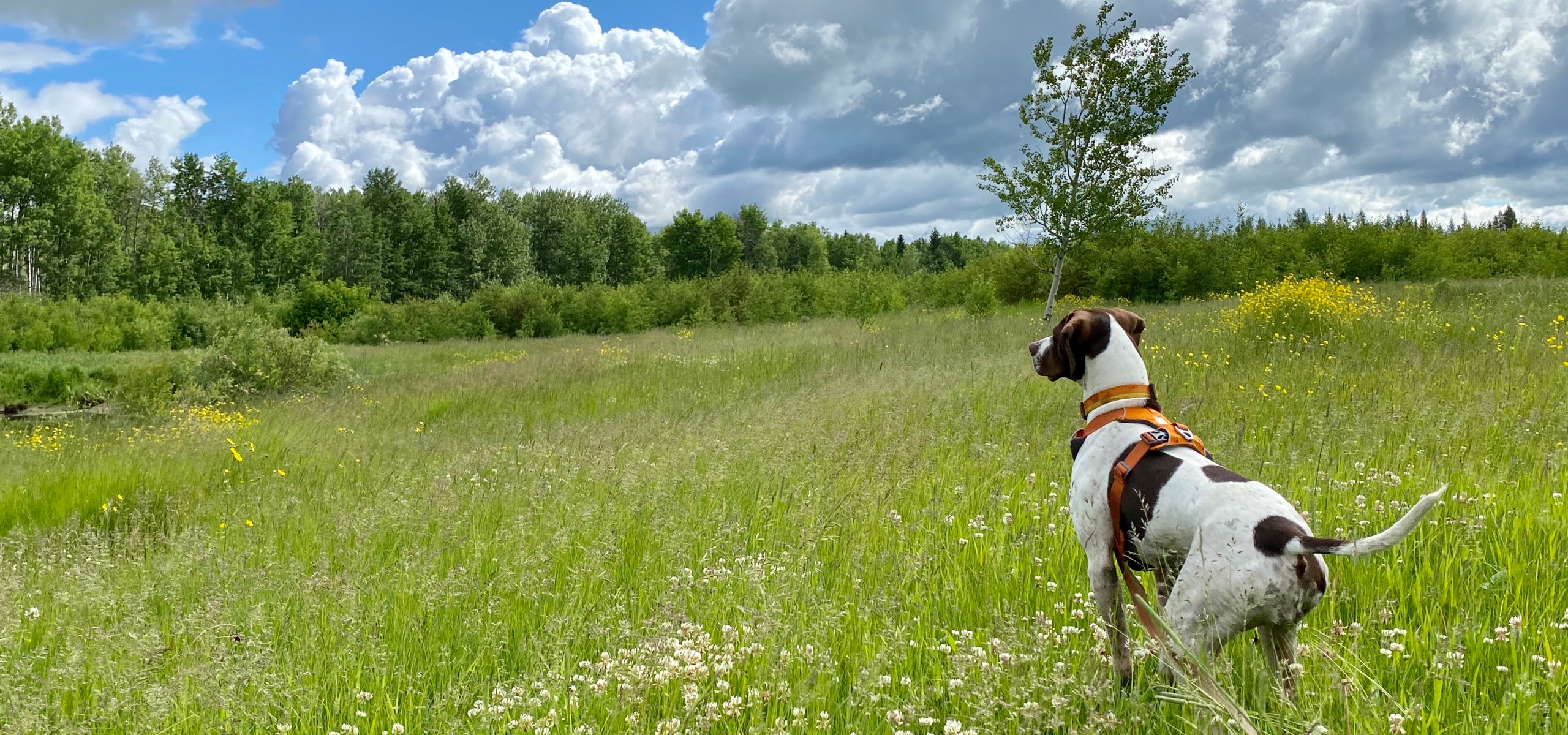
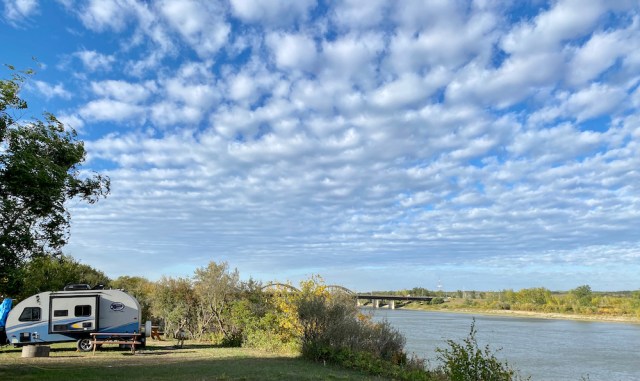
Saskatchewan is probably the last province you think of when it comes to truly great RV camping. This is probably thanks to the flat, endless, boring views afforded from the main routes across the province. Saskatchewan actually has some of the most amazing campgrounds I have stayed at. A lot of these are regional campgrounds, run by the towns they are near. As far as I’m concerned, Saskatchewan camping is one of Canada’s best-kept secrets, whether you are looking for an RV campsite for destination camping or for a nice spot to stay overnight on a road trip.
Why you need to get off the beaten track (a bit)
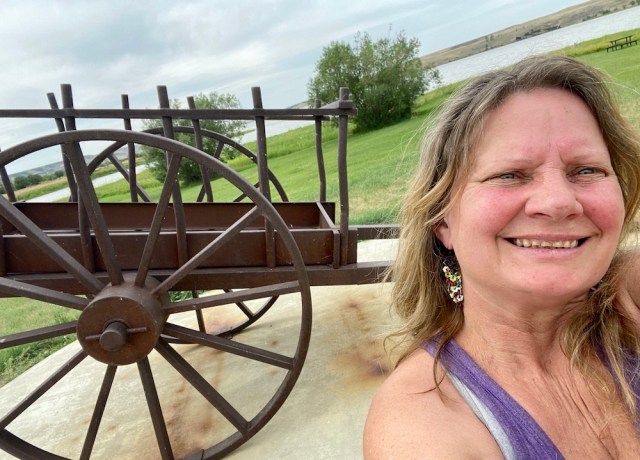
Saskatchewan is not an endless expanse of vast, empty spaces. But you’ll need to get off of Trans-canada Highway 1 and Highway 16 to really see the province in all it’s undulating glory. Don’t worry, the condition of the lesser travelled highways that I drove this year was nothing short of excellent. In the last few years, Saskatchewan has poured money into it”s highway system. The less frequented highways were in better condition than Transcanada Highway 1 or Highway 16. From what I saw on my travels this year, Saskatchewan highways are the best in Western Canada, with many wonderful little campgrounds in the Regional parks.
If you are crossing through Saskatchewan, I highly recommend trying a route that includes Highway 4, Highway 44, Highway 15 or Highway 11 for the often jaw-dropping scenery and friendly small towns along the way. After all, life is all about adventure.
4 RV Campgrounds in Saskatchewan You’ll Love
It was really hard to narrow it down to just 3. I should add that regional campgrounds are all around $30-$35 per night with water and 30 amp power. Saskatchewan Provincial campgrounds are around $40 per night with power only. Here are the criteria I used when I finally decided on which 3 campgrounds to include:
- Proximity to main highways
- Scenery including wildlife viewing
- Amazing night skies
- Friendliness
- Clean
- Dog Friendly
- SIte set up and general vibe
- Activities that include dogs
Without further ado, here are the 3 campgrounds we loved in Saskatchewan (not in any particular order).
Saskatchewan RV Campground #1: Saskatchewan Landing Provincial Park
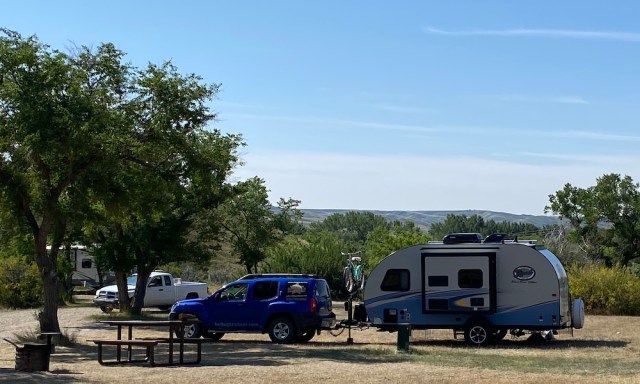
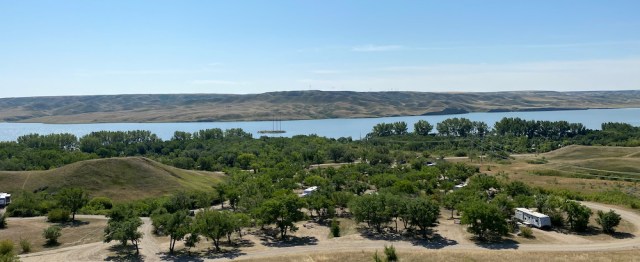
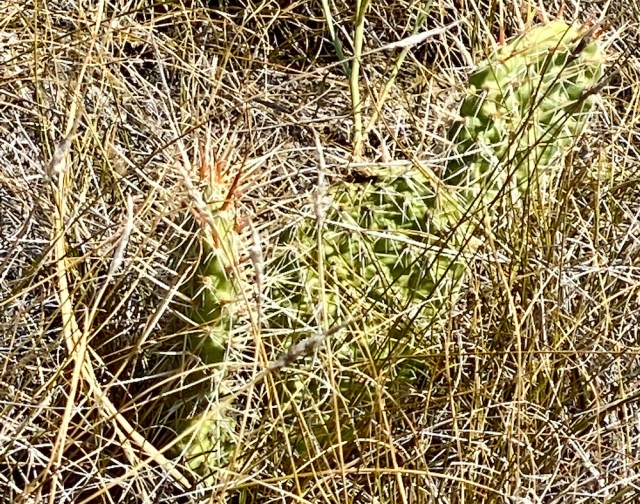
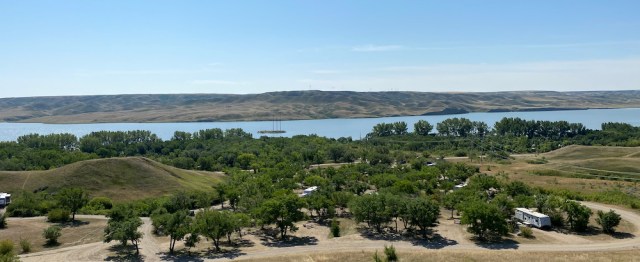
Drive between Swift Current Saskatchewan and Battleford on scenic Saskatchewan Highway 4 and you will find historic Saskatchewan Landing Provincial Park. Driving North from Swift Current, you will see a huge mansion built from river rocks on the left just as you come into the park. It’s worth stopping and exploring this unique, beautifully constructed building. Cross the bridge and turn right, and you will come upon an expansive campground, with campsites near the water, and up the side of the valley the campground nestles in. There are plenty of trees throughout the property, but they become more sparse on the hillside, which offers trails through prickly pear cactus, and overlooking ancient Red River Wagon ruts.
There is river access in the treed campsite area close to the water.
Saskatchewan Campground #2: Craik Regional Park
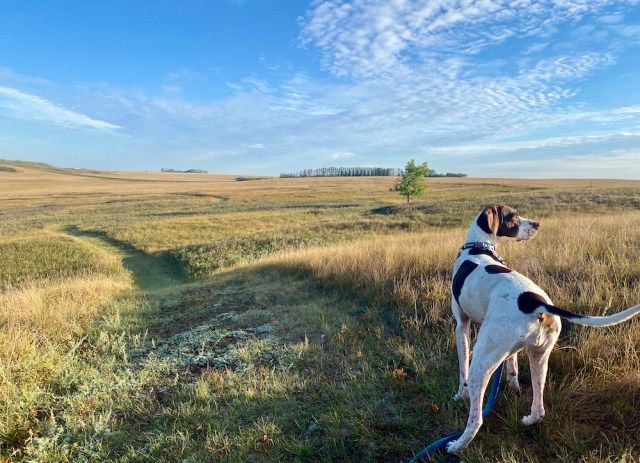
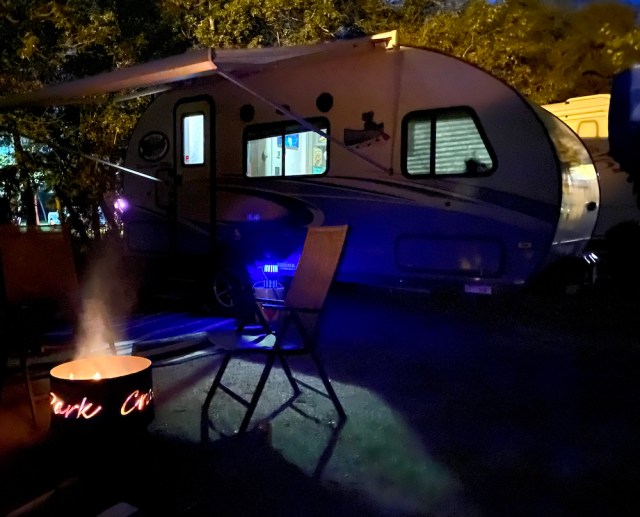
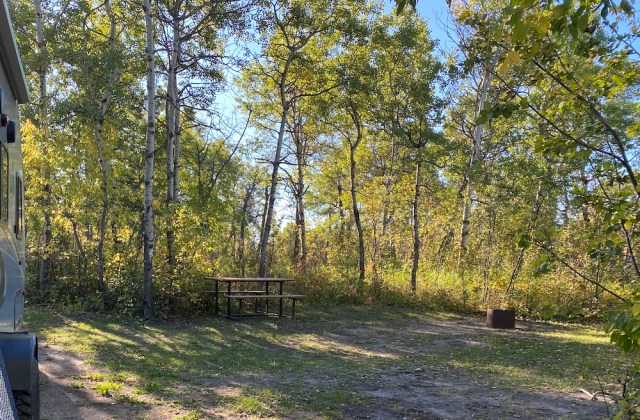
Craik Regional Park is located close to the very scenic Louis Riel Trail Highway 11. Like Saskatchewan Landing Provincial Park, this little campground is located in a valley. But this little valley is lush with Native Prairie grass, instead of the arid topography of Saskatchewan Landing. The park itself is well treed, and campsites are spacious, each with the usual firepit and picnic table. For $5 the friendly crew that runs the park will deliver a generous supply of nice, dry firewood, including kindling and even birch bark to get your fire started,
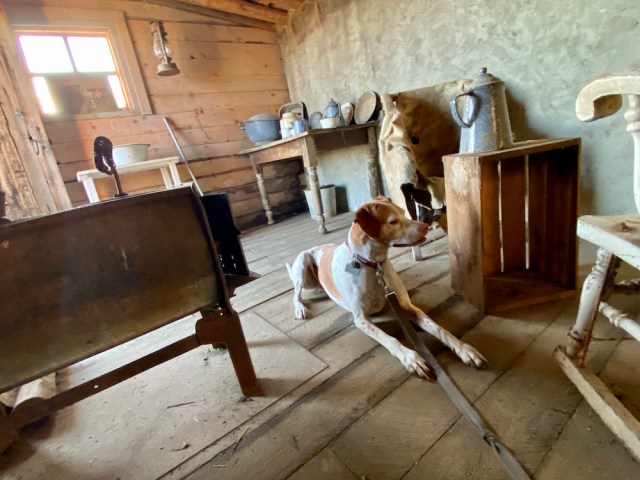
There are kilometers of trails to explore as you observe Cranes, Hawks and other wildlife. At night the sky is covered in an amazing blanket of stars and you can listen to the yips and howls of the local coyotes singing to each other. There is even a small dugout cabin and barn at the top of a hill overlooking the campground that you can go into and explore. Be sure to look for the ancient wagon ruts made across the prairie by the wheels Red River carts as homesteaders moved across the west. Across the road from the campground, you can find more trails, and a botanical garden.
Craik Regional campground is a unique spot, not to be missed on a journey across Canada
Saskatchewan Campground #3-Fieldstone Campground and RV Park
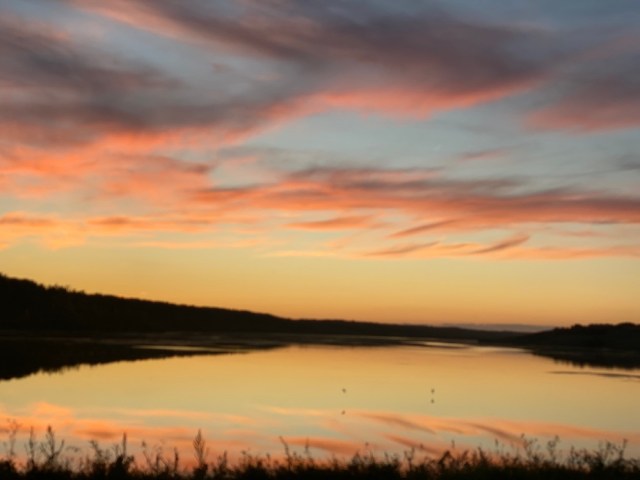
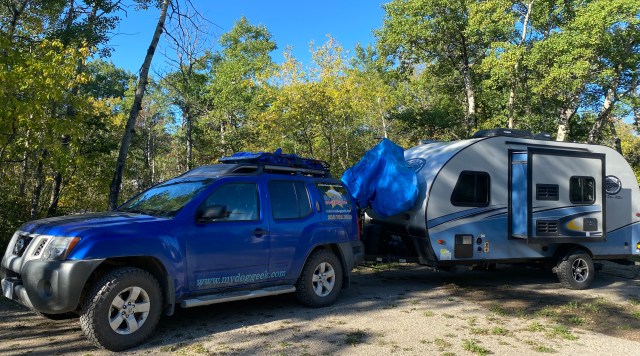
Fieldstone Campground and RV Park is situated along Trans-Canada Highway 1 near the town of Moosomin. The town of Moosomin has it’s own amazing regional park right on Moosomin lake. However, it is about 15 minutes drive down gravel roads. The regional park has a lot of activities for families. I was put off of camping there by signs that warned that any barking by the dogs would result in them having to leave. While the Arfpod gang is quiet generally, I can’t expect any of them to never bark. So, with that we were off to Fieldstone Campground and RV park, where we spent the night.
Fieldstone Campground and RV Park is a really nice campground, that is about 5 minutes from the Highway, so no matter what, there is noise from Highway 1. The park has enough amenities to make it a pleasant stay for anyone looking for a super private campsite.
First off, every one of this campground’s spacious, fully serviced campsites are pull-alongside, which means no backing in! Plus, the campsites are designed so the RV provides privacy by being parked across the front of the campsite. By the time we arrived from our jaunt out to Moosomin Regional Park, it was dark, so this ingenious campsite design was way more than welcome. Nobody really likes backing a trailer at night.
Now for the amenities: There were some nice trails cut through a pretty meadow. They made for a nice meander with the doggies. For those who travel with children, there is a decent playground, and a dugout swimming pond, complete with water features that make it into a fun water-park.
Share this:

Grilled Portobello Mushrooms

I’m excited ’cause it’s almost mushroom season on the coast. This is another amazing vegan recipe that anyone will love, even if you don’t do plant based. This delicious grilled mushroom recipe is made with portobello mushrooms, but trying it with bolete mushrooms is on my culinary bucket list. The secret is in the marinade, made with Bragg sauce, available at most grocery stores in the spice aisle. While you’re there, look for liquid smoke, it’s a staple in vegan kitchens and adds a nice smoked flavour to stews and chili too.
A Great Campfire Recipe
I love cooking food in my grill basket over a wood campfire. I don’t do propane barbequing, because wood is so handy and I really like the smoky flavour it gives to barbecued food. However, there’s no reason you can’t try this marinated mushroom recipe on a propane barbecue. I would even try it in the oven under the broiler for a late fall treat on a rainy day.
Grilled Vegetables Make This Recipe Perfect
The grilled veggies in this recipe make it more than just grilled portobello mushrooms. Grilled Tomatoes, onions, and peppers add nutrients add flavour. If you like, try adding a few Italian Beyond Sausages to add protein and make a complete and satisfying meal.
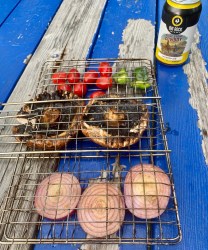
Marinated Grilled Portobello Mushrooms
Equipment
- Barbecue or campfire grill basket
Ingredients
- 4 portobello mushrooms
- 1 thick sliced onion I like red, but use what you have
- 12 Grape tomatoes
- 1 Green pepper
- 2 Beyond meat sausages cut in 1 inch pieces
Marinade
- 4 tbsp extra virgin olive oil
- 2 tbsp Brag Sauce
- 2 tbsp HP Sauce you can also use vegan worcestershire sauce
- 1-2 cloves garlic crushed and chopped finely
- 2 tbsp balsamic vinegar
- 1 tsp italian seasoning
- 1 tbsp lemon juice
- 2 tbsp liquid smoke
Instructions
Prepare the Veggies
- Wash and dry all of your veggies
- cut the peppers into bite sized bits
- slice the onion into 1/4 thick slices
- Put the mushrooms and veggies into a marinating tray or baking pan. Be sure the mushrooms are gill side up.
Make the marinade
- Whisk all of the marinade ingredients together until they are one beautiful, aromatic marinade.
- Pour the marinade over the mushrooms, veggies, allowing it to sink into the mushrooms, especially.
- Allow the mushrooms and veggies to marinate for 10- 20 minutes or even more, if you can.
- put the veggies and mushrooms into a flat grill basket and slowly grill over a fire until they are somewhat soft and the onions are translucent.
- Enjoy
Notes
Share this:

Photo credit- Lynne Fedorick
" data-medium-file="https://i0.wp.com/rpodadventure.com/wp-content/uploads/2021/08/bannock-campfire.jpeg?fit=300%2C225&ssl=1" data-large-file="https://i0.wp.com/rpodadventure.com/wp-content/uploads/2021/08/bannock-campfire.jpeg?fit=640%2C480&ssl=1" data-lazy-sizes="(max-width: 960px) 100vw, 960px" srcset="data:image/gif;base64,R0lGODlhAQABAIAAAAAAAP///yH5BAEAAAAALAAAAAABAAEAAAIBRAA7"/>
Bannock: Easy, Versatile, Deliciousness
Are you ready to have something better than bread for breakfast or a sandwich? When you are camping do you want to feed your kids something more nutritious than a hotdog or marshmallow, that can be roasted on a stick or even in a pie iron over a campfire? Well, don’t panic, there’s bannock!
Bannock: the versatile bread
Bannock is a versatile treat that is super easy to make and even easier to eat. I used to always make bannock Scottish style, in the oven, or else wrapped around a fat stick and roasted slowly and patiently over a campfire. But then one day, I ran out of burger buns. What to do?
Bannock to the rescue
Well, bannock to the rescue! It was time to try frying my bannock recipe. I had my little outdoor stove set up on Helen’s old picnic table on the beach. I heated up my cast iron skillet and melted a generous amount of vegan butter. When everything was ready, I added my bannocks, fried one side to golden deliciousness, and then flipped then over and did the same on the other side.
This Bannock Recipe is Best Enjoyed Anywhere
Helen and I assembled our bannock burgers, with all the fixings and ate them in chairs around an oceanside campfire as the seals and sea lions swam by. There is no going back to baked bannock, especially as I travel. I wonder at the marvels that could be- Vegan bannock pizza pockets, bannock pan pies…so much to try…my bannock bucket list could be endless.
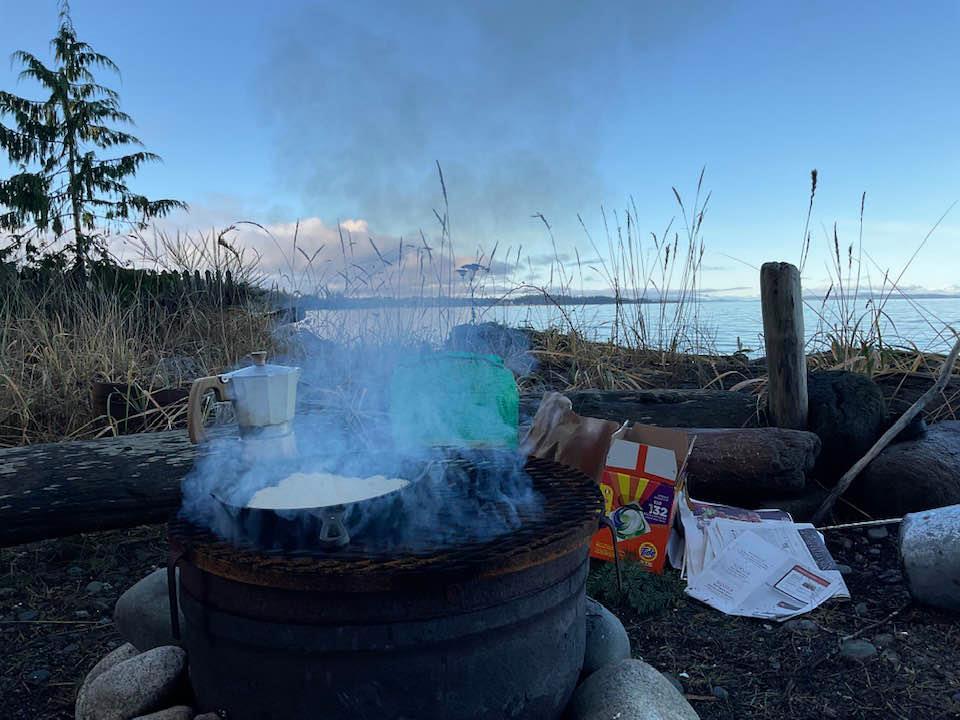
The Best Bannock Recipe
Equipment
- Cast Iron Pan
- Chafing Pan
- Large Mixing Bowl
- Spoon
Ingredients
- 2 cups All Purpose Flour
- 2 tbsp baking powder
- 1/4 tsp salt
- 1 cup water
- 2 tbsp flax or olive oil *optional if baking or roasting over a campfire
Instructions
- Measure all dry ingredients into a large bowl
- Mix well
- Add water and mix to form a soft, very slightly sticky, dough
- Divide dough into 4 equal parts.
- Roll each part into a ball with your hands
- Pat each ball to into a circle, 1/2 inch thick
- Heat 2 tbsp vegan butter or oil over medium heat in a large skillet.
- When the vegan butter has melted, add as many bannocks as will fit comfortably in the pan.
- Cook each side until golden brown on side, flipping as necessary. Cooking time per side will be 5 to 7 minutes. When bannocks are nice and puffy they are ready and delicious.
Notes
Share this:

The Truth about RV Living With Dogs
When I first started on this journey, I was warned “those dogs will wreck your trailer”. I thought “what a ridiculous statement”, as I looked at my 4 amazing dogs who had never before shown any aptitude for destroying anything, except maybe breaking some hearts. I realized I couldn’t just expect them to suddenly plunge into the RV lifestyle. Careful planning and preparation would indeed be necessary.
I eased all my dogs into thinking of the RV as home, wherever we happen to be. I always make sure I meet their mental and physical needs, every day. All day long. And this system seems to have worked. I can’t say without a little damage: Jolene (the lemon pointer) once went through an open window screen, but that was quick and easy to replace. I carry a window screen kit in my rv tool kit. Anyhow, nearly 2 years later, we are now in Alberta once again planning a trip across the Canadian prairies and beyond. Living with dogs in a small RV is entirely doable. You just need to prepare.
If you are planning to RV with your dog, whether full time or just on an occasional jaunt, this blog post is just for you. Here are 7 tips for successful RV living with dogs
Tip #1 for RV Living with dogs: Deal with behaviour issues before you go

If your dog is prone to having an anxiety attack when you are out of sight, living in an RV is not going to suddenly make him suddenly become more comfortable when you are gone. If you have a reactive dog who is either frightened in new situations, or who barks at, lunges at or bites people or other animals, life on wheels will not cause him to suddenly become chill. Reactive behaviour, aggression and separation anxiety always get worse with constant changes to the environment. Help your dog to get over them before you begin RV living.
Get Expert Help
If you aren’t an accredited dog behaviour expert, the easiest route will be through working with a CPDT-KA or KSA dog trainer or IAABC Dog behaviour consultant. For helpful dog training and behaviour tips, check out my dog training blog here: https://mydoggeek.com/category/dog-training-tips/
Tip #2 for RV Living With Dogs: Check ahead that your campground is dog friendly

Do some research online and if you are booking into a private campground, be sure to let your host know you are bringing a dog or three. They like to know these things. There are some great campgrounds for camping with dogs out there. Some even have amenities such as fenced dog parks, pools for dogs, and dog activities such as training and agility courses (ok, these ones are in the US, not in Canada yet)
Don’t get gouged:
Always be careful where you stay: We got gouged on an overnight stop in the South Okanagan when we were charged $20 for each of the 4 dogs. Some campgrounds charge a “head tax” on dogs.
Ask About Breed Bans
Some private campgrounds have breed specific bans, so If you are travelling with a bully breed, Rottweiller, Boxer, German Shepherd Dog, or other largish dog, ask before you reserve. There is nothing like getting to your campground, travel weary and anticipating a restful stay, only to find out they don’t want your dog there.
Provincial Parks or National Park Campgrounds are a good option
Provincial and National Parks campgrounds and Forest Recreation sites are a good choice for travellers with dogs, regardless of breed. There are no breed restrictions, and although dogs have to be on leash, there are usually a few choices of trails to walk on.
Practice Makes Perfect- Photo Credit: Lynne Fedorick 2018
RV Living with Dogs Tip #3: Practice makes Perfect
Practice camping in your RV with your dog before you leave the driveway. If you practice living in the RV at home with your dog, he’ll regard it as home. I stayed in the Arfpod for months with for months in my dogs while my house was staged for sale. It gave the dogs a chance to learn that the routine was always going to be the same. After a short time (like me) the 4 dogs really prefered the cozy space of the the Arfpod to being in the house.

RV Living With Dogs Tip # 4: Keep a regular routine
Dogs love a routine. Schedule doesn’t really matter much, but the order and way you do things help a dog to trust the universe. If your dogs routine follows the order: Walk, training, breakfast, relaxing on the couch, play, train, cookies, relax, walk, eat dinner, cookies, relax, then he’ll be happiest if you keep the same basic routine wherever you go.
RV Living With Dogs Tip # 5: Exercise Creativity
You should always leash your dog on walks at campgrounds or in any environment that’s strange for your dog. Your dog will be distracted in a new environment and may not have the same reliability as he does at home. He may even be more reactive than usual to new dogs or people.
That being said, walks on leash force dogs to walk at an unnatural pace. Dogs off leash normally run or trot and only walk after they are good and tired. Leashed walks rarely provide enough exercise for a medium or large sized dog. Dogs need aerobic exercise and a chance to stretch their limbs in a way that builds and sustains muscles.
Luckily there are lots of ways to help your dog to get a good daily workout even when you are travelling. Here is a list of our favourite doggy workouts, that are easy to do anywhere.
Fetch: Many dogs love to play fetch. If you can’t find a safe, off leash area, your dog can play fetch on a long line. Here is a link to my video about training a retreive:
Dog Parkour: Dog parkour uses objects in the environment as agility obstacles for exercise, mental stimulation and a whole lot of fun! Find out more about dog parkour here: http://www.dogparkour.org
Yoga Ball Balancing: Use Yoga Ball training to help strengthen your dog’s core muscles while providing mental stimulation.
Acrobatic Tricks. Acrobatic tricks are a fun way for young dogs to burn off a lot of energy while building and maintaining fitness and coordination. Hoop jumps are an easy trick to teach most dogs. Here is a video about how to teach your dog to have fun jumping through a hoop.
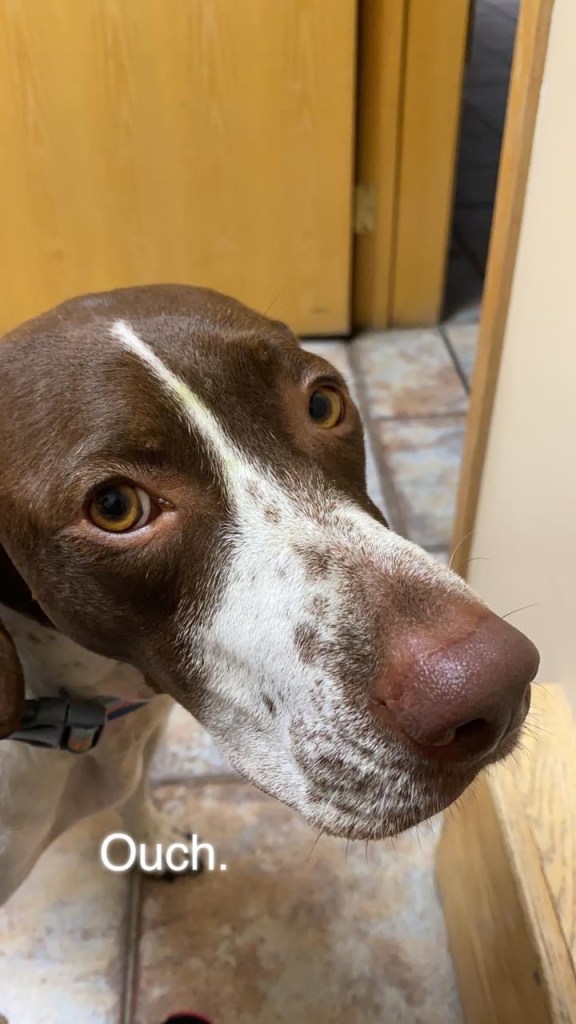
Tip # 6 for Living With Dogs in an RV: Have a veterinarian handy
It’s really, really important to find out where the nearest veterinarian is, in case there is a veterinary emergency. Last week, young Annabelle the Elhew Pointer had a wrestling match with the neighbour’s barbed wire fence at 10 pm at night. We were glad to know the local veterinarian was Rocky Rapids Veterinary Services. Annabelle had multiple deep wounds on her left front leg and a gaping wound on her chest. I was glad to be able to have a vet meet us and perform emergency surgery at 10:30 pm. Annabelle is on the mend now, thanks to the speed at which were able to get services. Dealing with any emergency is always easier when we are prepared.
Tip #7 for Living With Dogs in An RV: Bring A Dyson Cordless Vacuum Cleaner
Considerable dog hair and bits of the flotsam and jetsam of camp life come into this little Rpod 180 every day. Having a Dyson cordless vacuum to clean it up is essential to not living up to my neck in dog hair and additional stuff. Even with their short coats, the pointers shed their weight in hair. I could probably make a whole other dog every week from it.
I’ll admit I was hesitant at first to buy one of these expensive little vacuum cleaners. They were far more expensive than anything else in the vacuum department at Bestbuy. But I am so glad to be able to thoroughly pick up messes quickly and easily without any hassle. After 3 years the Dyson is still undaunted by the massive amount of dog hair it inhales. As a bonus, the Dyson takes up little room and stores out of site on the wall in the bathroom.
Share this:

“The robb’d that smiles, steals something from the thief; He robs himself that spends a bootless grief.”
William Shakespeare, Othello
Stuff: A paradox in Drayton Valley
When I started this journey a year and a half ago, I did so with the idea that RV living would be a temporary adventure until I found a suitable piece of land and built a small house in Alberta. I had packed up my stuff, all the things that I used to fill up my house, (minus the furniture and larger bits) into boxes and hinged lidded Rubbermaid trunks. There was a lot of stuff I didn’t want to part with: Old Photos, books, carpentry and renovation tools, rapidly becoming obsolete electronics, dinnerware and all the necessities for performing with my trick dogs as part of local events, (should Covid health guidelines ever relax).
Even after I downsized, these were were among the many items that I shipped to a 10×8 foot locker in a storage facility in Drayton Valley, Alberta. The place promised the best security and used a special coded phone app to open the automatic gate. The woman at the front desk promised the site was constantly monitored by security cameras and proudly proclaimed “We’ve had only ever had one theft incident here.”
After living in my RV for a year, I changed my mind about buying land and resurrecting my dog training business in Alberta. I was really happy in my RV. The Arfpod gives me everything I need in a living space, plus I have the ability to be completely mobile, visiting our friends and family year round. The Arfpod is perfect. Except it doesn’t fit all my stuff.
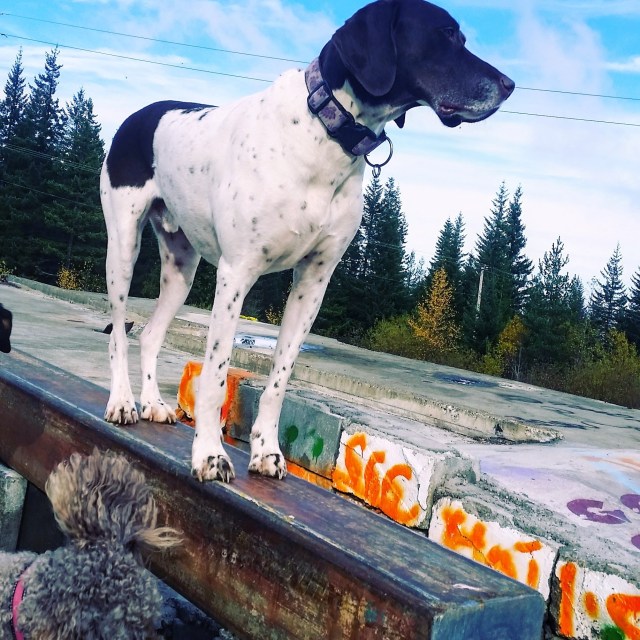
Balance
But I can spend winters with friends on the beach, working and helping people with dog behaviour problems on Vancouver Island. I spend summers on the prairies, visiting Georgie, Stella, and the rest of the family. It’s a perfect balance. My stuff could stay in storage in Drayton Valley for the time being. But my 5 year plan is to keep this wonderful mobile lifestyle, so the cost of storage would be over 7000 for that period. Trick dog equipment for trick training classes and West Coast shows at local events and charities would be inaccessible. Payload capacity limits meant it couldn’t all fit in my vehicle when I headed back out to the coast. I would need to get it shipped to a facility in Black Creek. Another $1200. So what to do?
I have to admit, I stressed about all the stuff that was tucked away safely at Drayton Valley Storage. I resolved to give more stuff away, and then get the remainder shipped back to the coast, with the trick dog equipment and have it stored there. Having made this resolution, I went to retrieve a few items, including Earl’s beloved red toy piano from my storage locker.
I opened the 3/8 inch plywood door to my locker, walked in, and went to turn on the light. The little room remained darkened. “Why?” I wondered. I don’t ever leave lights on, so it seemed odd that the bulb would be burned out. But okay. Whatever. I went to get Earl’s piano out of the trunk. The trunk was not there. I looked and saw the portable PA speaker we use for shows was gone. Along with all my saws and all my tools. Every last box had been opened and rifled through, except those that were labelled “books”. Some entire boxes were missing. I was in shock. Indeed.
Nothing as it seems
I looked at the 3/8 inch sheet metal screws hanging loosely from the hinges on the outside of the locker. Evidently, the thieves had easily taken my door off the hinges and had spent a long time in my locker going through stuff and picking out what they wanted. Why they took trick dog show props is beyond me. I would have to get my remaining stuff out of there. Thieves always return and as I loaded up a few dishevelled boxes I saw the missing chain link fence on right side of the yard. The place was not secure at all. I loaded up what I could with 3 dogs in my vehicle and figured I should inform Candice, at the front desk that someone had removed my door from the hinges and robbed me blind. She would no doubt be concerned.
Candice didn’t look at all surprised when went into the office and I told her. After a few seconds, her eyes shifted up from her computer, and with apparent effort, she stood up from her seat. She says bluntly to me: “You must have been targeted. No one else has reported being broken into” Since no one but me knew where my storage locker was, this was impossible. I tell her about the other lockers in my block that showed signs of either forced entry, or hanging hinges. Maybe other locker owners should be informed. Candice doesn’t blink, and firmly says that there were no other thefts.
We emptied the locker by the end of the day, and I tried to file a police report. It took 4 days before an officer called me to get the full report, and there is probably no hope of ever seeing any of our stuff again.
There is a good possibility this was an inside job with facility staff either being a part of the theft, or turning a blind eye to it. Police don’t receive enough funding here to properly investigate property crimes unless there is a threat to human life involved.
Drayton Valley property crime
But rampant property crimes are so widespread in Drayton Valley that absolutely no one is unscathed by them. A current community project being funded by private donations is the new community aquatic centre. The building is in the process of being framed with tall steel posts and beams triumphantly marking the spot that will house the new aquatic centre. The site is surrounded by a compound of steel construction fence panels. Last week, to no one’s surprise, thieves broke into the compound and robbed it of construction materials and tools.
Poverty pits an entire community of neighbours against one another here in a relentless battle of wits. Everything not nailed down or locked up, including family dogs and livestock gets stolen here. There is so much extreme poverty in Drayton Valley due to job losses, that people perched on the line between honesty and a life of crime is easily pushed over the brink into the latter. Poverty, drug use, a lack of police services has caused the property crime rate here has climb to extreme levels. Criminals have learned there are no police services here between shifts and on weekends. They come from all over Alberta to target this little town that once thrived on oil and gas money.
Anyway…
I didn’t set out to do a dissertation on property crime in Drayton Valley or to write a harsh criticism of the town. Drayton Valley is struggling to do it’s best under the burden of ridiculously hard economic times. In some ways things seem to be improving here since last year. I see many more people here busy working and bustling about. A new painted mural in the business district of Drayton Valley has a bison’s head on either side, each staring at a script that spells out “Strength”. And the little town will sure need strength to draw it through these difficult times.
I’ ve been relieved of anything that had value in any of Alberta’s pawn shops. l still have boxes of old photographs, old books and writing projects that I never finished from back when I had a clackity old Underwood typewriter and some art supplies. I have very little stuff left now. While I am not happy to be involuntarily stripped of my material possessions, It feels kind of good not to have to worry about having them anymore. I actually feel even more free than when I drove into town worrying about what I was going to do with all my stuff. Freedom is kind of frightening when it first arrives and beckons us from the comfort of old habits. But I am getting more than used to it. I am really starting to like it.
Life is good
On today’s schedule are: A bike ride with George and Earl , cuddles with Stella, bikejoring with Annabelle, acrobatic trick practice with Jolene and then preparing a book submission for a publisher. At the end of the day, I will raise a glass or two of excellent scotch with two of my favourite humans on the planet. I really like this life.
Share this:

Photo Credit: Lynne Fedoricxk
" data-medium-file="https://i2.wp.com/rpodadventure.com/wp-content/uploads/2021/07/Wapiti-1.jpg?fit=300%2C208&ssl=1" data-large-file="https://i2.wp.com/rpodadventure.com/wp-content/uploads/2021/07/Wapiti-1.jpg?fit=640%2C444&ssl=1" data-lazy-sizes="(max-width: 2560px) 100vw, 2560px" srcset="data:image/gif;base64,R0lGODlhAQABAIAAAAAAAP///yH5BAEAAAAALAAAAAABAAEAAAIBRAA7"/>“When even shadows need shadows to cool off, you must know that the weather is incredibly hot!”
― Mehmet Murat ildan

Heat Wave
The record heat wave the West was experiencing brought blistering heat here and everywhere else in the Western region of Canada. We had narrowly escaped the 42-degree heat of Blue River, and continued through to the immensely popular Wapiti campground at Jasper National Park. We were lucky to get in without a reservation, but really only spent the night because I needed rest. The Quebecois national park attendant warned me that the female Elk were particularly aggressive this time of year because they were protecting young calves. Of course, there were also the bears that are ubiquitous to Canadian Camping as well. Neither of these seemed as much a threat to me as the dense population of humans camped out in clusters of tents that sprawled throughout the open landscape of the sparsely treed campground.
City of Tents
The sites at this campground are open to neighbouring campsites, but they all seem to have incredible views of the surrounding Rocky Mountains. Neighbouring campers take care to avoid eye contact with one another, and if some sort of meeting is inevitable at the communal dishwashing sink, a polite and brief exchange of awkward “Hi!”s ensues as dishes are washed and then rinsed and before campers are on their way. It is like a small city of tents nestled in this park in the Rocky mountains.
There is no cell service here. I think that is what makes people greet each other at all instead of craning their necks down at cell phones.
Multiple large piles of firewood stand as rapidly disappearing monuments to recently logged pine and spruce trees. Two girls watched from a neighbouring campsite as I (deftly) backed into my small campsite and carefully lined the trailer up (with precision)against three pines at the back of the campsite. This would be a fine place to settle for the night, even though there were no hook-ups.
The World is a Thirsty Place
Even in this fading sunlight, It was too hot to walk the dogs. So I busied myself filling water bottles at the dishwashing sink, since there hadn’t been potable water at our last few stops in the North Thompson and we’d already used up the 11 gallons that we travel with. The 3 road trip addled dogs accompanied me. A middle aged Malaysian woman stood at the sink and washed dishes until she saw us. Oh myyyy….your dogs are very thirsty. Let me fill your bottles. How can you keep them from having water? That’s so meannnnnn….” She chided (with some glimmer of delight in her dark eyes) as she filled my bottles for me. Yeesh. The dogs were thirsty. I was thirsty. “The world is thirsty right now” I thought. I said “This water is for them. Thank you for your help!” We now had a gallon of water. We would have to conserve it to last through the night. I dropped two ice cubes into a glass and covered them with the Shelter Point Scotch I have for such emergencies.
Little Fires Everywhere
I didn’t avail myself of the Park attendant’s invitation to have a campfire. It was just too hot. As night fell, we took a much-needed stroll around the dirt roads of the campground and saw the campground was dotted with the orange glow of campfires. The kindling on what was once a forest floor crunched under my feet as I cut through an empty campsite on my way home. It was too dry for a campfire.
Share this:

The joys of travelling on Highway 1 through BC
This year, I decided to travel an easier highway than the Coquihalla. We traveled through the start of a heat wave on scenic BC Highway 1, through the beautiful Marble Canyon provincial park. I loved this route. It was gorgeous in it’s barren landscapes dotted with pine groves and blue-green sage bushes. The sparsely travelled highway winds it’s way along through sleepy towns and has plenty of pull-outs and rest stops where we could stretch our legs, give the dogs water or get a bite to eat. By now, you’ll know that when I say “we” I am referring to me and the dogs I work and travel with. Travelers with dogs greatly appreciate such accoutrements, which are rarely available on the immensely more popular Coquihalla Highway.
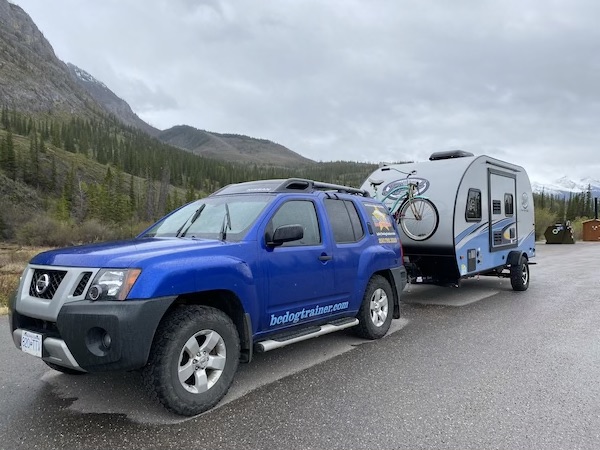
I like to drive a little slower than many travellers when I am asking my Xterra to tow the weight of the Arfpod. Hills are taxing on a vehicle, whether going up or down them. I want my Xterra to be worry-free for a few more years, so I Indulge it when I can. I really loved that there were big rigs and semis on this highway. Passing lanes are plentiful, something where I find the Coquihalla lacking.
The only really tough climb on BC Highway 1 for the Xterra was a long steep hill called Jackass Mountain. It was hot enough through there that when the engine thermometer on the control display climbed, I pulled over to give my Xterra a much-needed break. It was by then too hot to walk the dogs around on the pavement of the pullouts. At least it was great to have plentiful and scenic rest areas. We had some great camping just west of Kamloops at Juniper Beach along the way.
An oasis by the mighty Thompson River
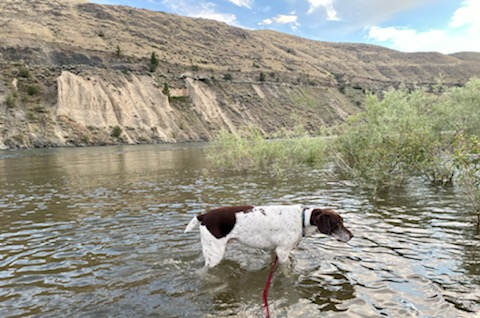
Juniper Beach is a smaller Provincial Park Campground. It has the atmosphere of a gorgeous little oasis planted with Juniper bushes and peacefully shady Tamarac trees right on the edge of the Thompson River. As I was setting up, the aroma of frying trout (hope I’m not going to vegan hell for saying that?) gave me the impression that there was good fishing in the area.
Share this:

RV Maintenance
There are many things I don’t miss about living in a sticks and bricks house. Not the least of these is the endless, never ending list of house maintenance chores. Because of this list, I don’t think I ever sat and just relaxed in my house like I do both in and out of my R-Pod.
Moving into an RV doesn’t get you out of household maintenance chores though. As a matter of fact, with an RV, skipping or even simply delaying maintenance jobs can get you into real trouble. There are just fewer jobs to do, and most of them can be easily completed in a few hours.
Here is a list of jobs I do on the Rpod before every trip:Fix things that broke indoors and tighten up or reseal any loose plumbing
RV Maintenance Job #1: Repair RV Interior items as necessary

The truth is, everytime I tow the R-Pod anywhere, it’s like a miniature, roving earthquake. I have to tie down everything. I alway put spring bars in the kitchen cabinets to keep pantry items from bouncing out of the little kitchen cabinets above the dining area/couch. Plumbing fittings and cabinet hardware loosen and need to be tightened. Plumbing joints all get checked and resealed as necessary. Moisture is the enemy of RVs. After last year’s ramblings the bathroom door managed to re-adjust itself, so it no longer catches on closing. I haven’t figured out an easy fix for this yet.
I like to change my smoke detector battery every 6 months. You might think this is excessive. I justify it because every morning it lets me know that my toast might start burning soon. I don’t know that makes a smoke detector chew batteries faster, but it’s not a chance I want to take. This is also when I turn my fire extinguisher upside down and give it a few shakes to keep it operational.
RV Maintainance Job #2: Clean, polish, protect
Before I leave on my trip, everything has to be cleaned and polished. Laundry has to be done including the amazing area rug I got from Marshalls last year. This area rug is amazing because it fits my floor perfectly, it’s machine washable and fast drying on an awning arm or the spare tire mount. And it looks good too!
The outside of the Arfpod gets a thorough inspection and wash too. I use a special cleaner that’s meant for fiberglass and then follow that up with a gel coat protectant. As I go, I can check for spider cracks or anything else that might let water in. Last year’s ugly and angry winter storms brought down some branches that cracked the gel coat in a couple of places. A bit of a concern, but I am going to get it fixed when I get back in the Fall.
I also like to dress all the rubber seals that keep moisture from seeping through around the doors and the slide twice a year. The product I use is made just for this purpose by Camco.
The stabilizer jacks, and hitch get greased every 6 months so they keep working, even with my amateur-hour backup and parking gaffs.
RV Maintenance Job #3: Exterior caulking
Every 2 Years caulking needs to be stripped out and replaced with new caulking. I read the directions to the part about stripping the old caulking, and decided to have the caulking replaced by my local RV dealer. I know many RVers who do this themselves, but it sounds like a horrible job and besides I like to support local business.
RV Maintenance Job #4: Tires and wheels

Because I tow my trailer more than the average camper, I check my tires before every trip and make sure they are inflated to 50lbs PSI. I carry a rechargeable tire inflator/battery charger.
Retorque the wheels before every trip. One of the things I had to learn as a newby RV owner was how to use a torque wrench to make sure my trailer wheels don’t loosen or even fall off.
RV Maintenance Job #5: Tow Vehicle Maintainance

Every time I have ever needed a tow-truck on a road trip, I have been introduced to a new modern day, land-pirate. So, I like to avoid vehicle problems on the road. It’s really important to stay on top of vehicle maintenance tasks like changing out all the vehicle fluids and getting a checkover from my trusty mechanic, Sheldon. I want to give him a plug here, because he is super awesome.
The last Job #6: Lose Weight

My Nissan Xterra tow vehicle is a pretty amazing little truck. I want to keep it that way, so before I make it tow the Arfpod, I shave weight off wherever I can. I always accumulate things I don’t really need or use. Liquids are deceptively heavy. A single gallon of water weighs 10 lbs. So I empty all the tanks, except the freshwater tank, which I leave just 10 gallons in for travelling with. I even try to lose weight myself, but so far my body maintains a little bit of extra me. Perhaps in case of a famine. Who knows…haha!
Share this:

Photo by Leah Kelley on Pexels.com
" data-medium-file="https://i0.wp.com/rpodadventure.com/wp-content/uploads/2021/06/pexels-photo-3935702.jpeg?fit=300%2C200&ssl=1" data-large-file="https://i0.wp.com/rpodadventure.com/wp-content/uploads/2021/06/pexels-photo-3935702.jpeg?fit=640%2C426&ssl=1" srcset="data:image/gif;base64,R0lGODlhAQABAIAAAAAAAP///yH5BAEAAAAALAAAAAABAAEAAAIBRAA7"/>
Travel between health districts is banned in BC for now. With Covid cases rocketing across the prairies, and only a handful here on the island, it seems prudent to stay put. Here in the sun. On a beach. On the East coast of Vancouver Island. While I miss little George, wee Stella, and the kids, and an adventurous way of life, exploring the wonders that Nomad life and Canada hold, here is not a bad place to have to stay put. In the meantime, I get to prepare for future journeys when things open up. The first step, travel planning, is the most fun.
Travel Planning
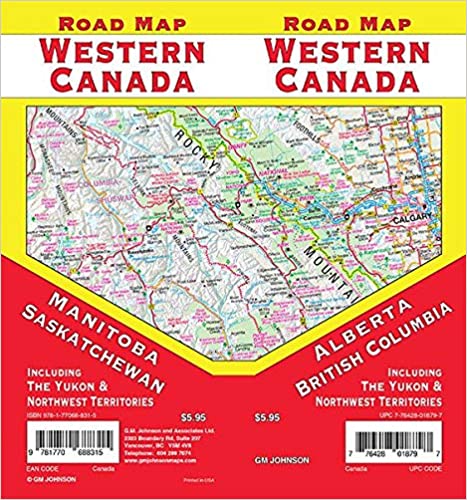
The first thing I did was order some British Columbia, Alberta, Saskatchewan and Manitoba road maps from BCAA. BCAA and their affiliated Automobile Associations across North America offer free road maps as one of the benefits of membership with them. Other benefits include roadside assistance which can be costly if you break down on the road, especially if the only towing service is Pirate Pete’s Recovery, . I highly recommend anyone setting out on a road trip in their RV get an RV membership and travel medical insurance with their local Automobile Association. It’s just peace of mind so we can enjoy the journey. There are other organizations that offer roadside assistance packages especially for RVs, but after thorough research, I don’t think they have any advantages over BCAA’s RV Roadside Assistance program.
I also ordered a great Roadmap of Western Canada from Amazon.ca, which has rest stops, camping spots and of course, many detailed routes throughout the Western provinces. It has more detail than the BCAA maps, and more knowledge is better, right?
So, why paper road maps, you are (maybe) asking?
Well, the thing is, Google maps and Apple maps can only direct you as long as there is a cell signal. And there are many places (like the Rockies or Rural Manitoba) where there is no cellular service at all, and Wifi may only be available in the public libraries in small towns along the way. Which doesn’t really help at all.
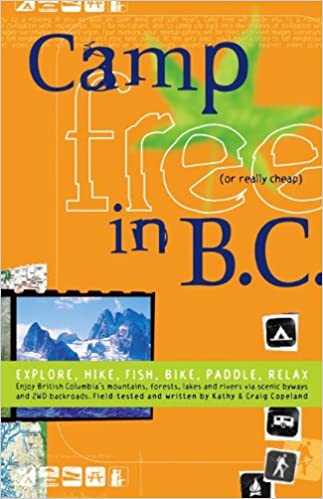
I also got a very cool book called Camp Free in BC from Amazon.ca. It has about 50 different campsites, mainly Forest Service Campsites which are basic enough, but fulfill the need for peaceful boondocking near easily accessed yet amazing lakes (and some rivers) for free, or at least really cheap.
My R-Pod is well equipped for boondocking, with a 60 gallon grey tank, a 60 gallon black tank and a 30 gallon fresh water tank. It is also set up to run things on solar power, so I feel pretty well equipped for boondocking at some of the sites mentioned in the book. But I am not gonna lie. I really like my conveniences, so boondocking is just going to continue to be an option.
Testing the waters of Klaklamaka Lake
On a recent, Saturday trip for work up to Port McNeill, I checked out one of the campsites that Camp Free in BC listed, at Klaklakama Lake. As promised, it was an easy drive to the lakeside campground, with two well-designed sites for two campers. Each site had a picnic table and a firepit. There was even an older-looking, green-painted outhouse. When I got there, there was no one else there. The dogs had a swim and I was about to shuck clothes and walk into the warmish, crystal clear waters from the sandy beach at the lower campsite when the grumble of a big grey Dodge Ram diesel truck with a camper on the back arrived next to where I was parked.
The 50ish male driver and his female companion jumped out and asked me if I was going to be there long, since they wanted my spot. I don’t know if it was normal camper etiquette. I thought it was pretty rude. The pair probably were probably regulars there so I told them I’d take off in half an hour. They stood and stared impatiently at me as I had my picnic lunch and played more with my dogs and then got everyone and everything packed up.
Anyway, it was a nice little spot, and it made me even more interested in checking out some of the other local sites in the little book.
Share this:

The saddest days come when we inevitably say goodby to friends, whether they are two-legged or four-legged. Today was one such day. Days like these are filled with reflections and gratitude for having been graced with such beauty in the rear view mirror of our lives.
Aside from my own dogs, there are two dogs who have lived here by the sea with Helen since long before we met. Anyone who visited this place would have been given and enthusiastic greeting by Nell the gregarious black labrador retreiver and her little sidekick, Annie the elderly West Highland White Terrier. On Saturday, Annie was suddenly acting strange, finding weird places to hide and curl up in the house, and when we’d find her, she’d look annoyed and shuffle her way out to a secluded spot in the garden.
Before we retired after our regular Saturday movie night in Helen’s house, we went out to the garden to look for little Annie. She was found curled up in the woodshed. As I carefully picked her up I knew she wasn’t going to make it through another day and maybe not even through this night. I just felt it and I could tell little Annie had already accepted that. I carried her in and gently put her on her normally self-designated spot on the couch in the cozy warmth of the woodstove.
Sunday morning I would find Helen on the couch, tearful and holding little Annie for the last time. The little dog was already gone, another bright star to dot the night sky. Annie will be missed by all of Helen’s many friends and family.
Travel adventures are on hold
Each dog I have had, has represented a chapter in my life, such as numbers could never represent. One day, I may write a book about that. But for now, I will share a “travel” update.
I put the word “travel” into quotes. Why? Widespread and rampant Covid variants have spread throughout Western Canada. The BC government finally did the right thing and banned travel between health regions. BC Ferries is not allowing RVs of any kind on any sailings from Vancouver Island unless they are returning home. The RCMP is conducting spot checks to see where people are headed. Word has it that campgrounds are closed throughout BC. It’s not a good time to travel at all. The travel ban will be in place in BC until the end of May. But here I am stranded on a beautiful Pacific Island on a beach beside the sea.
Travel Plans
I am lucky enough to be getting my first vaccine next week, which will be followed within 2 months by a second dose. I should be able to travel then. So, my travel planning has continued. There are so many exciting and intriguing places to see throughout BC, Alberta, Saskatchewan and Manitoba. So, I bought a bunch of road maps. Last summer I found that Google maps had some strange and very creative ideas about highways that could be travelled, and I wound up on some fantastic adventures.
As we were outrunning a really ugly Tornado nearish to Regina, Google Maps took me through Saskatchewan over crumbling back highways and gumbo dirt roads probably only used only workers at the huge farms throughout the regions. When you are on these narrow, shoulderless roads, there are long stretches where you can’t turn around anywhere, and so on you must press. And by then a mix of curiosity, bewilderment and road weariness takes over so when you get to a spot you could conceivably turn your rig around, you don’t. You carry on in amazement and utter awe that Google Maps found this back highway to direct you down. It was for sure one of the most scenic routes I have been on.
Highway 4 Between Swiftcurrent and the Battlefords Saskatchewan Crossing was a great spot. Saskatchewan cactus: Who knew?
When I returned to BC, on our way back to the island, Google Maps directed me down mountainsides, over gravel wilderness roads and straight through a cattle ranch, past recent landslides and near ghost towns.
In Alberta Google Maps took me over some pretty decent highways through pretty country and to the wonderful discovery that in Alberta’s provincial campgrounds, I wouldn’t have to back in! I have to confess, backing the trailer is not my long suit, especially when there is always a sparse but predominantly male crowd observing like the multiple judges at a figure skating competition who forgot to bring their scoreboards and brought beverages instead. My white and brown German Shorthaired Pointer, Earl always barks his loud encouragement at these special times.
Anyway, folks: The good people who planned Alberta’s campsites made sure you could pull through at each and every one of Alberta’s provincial campgrounds. The one’s that I stayed at anyway. I had to like that.
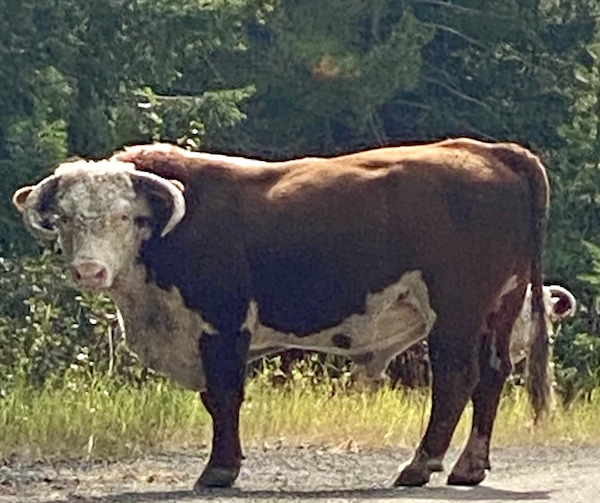
When I returned to BC, on our way back to the island, Google Maps directed me down mountainsides, over gravel wilderness roads and straight through a cattle ranch, past recent landslides and near ghost towns.
Anyway, all those surprise journeys made wonderful memories, but they also made me decide I wanted to feel good, old fashioned travel maps in my hands instead of trusting Google and my cell phone provider, which happens to be Telus right now. Which brings me to the subject of wifi and cell service when I travel.
How to stay connected during travel
So, most RV parks offer some sort of Wifi connection. Friends and family always have wifi too. The trouble is, that we are often camped too far from the office or house to pick up the wifi signals. I guess I could get a wifi booster to help with this. But for the relatively few number of times I stay in RV parks, I felt it was better to get the fattest unlimited Data plan Telus sells and then hotspot with my phone. Telus also sells a data hub, but it seemed to me to be an even more expensive option than using my phone as a hotspot.
Most of the time this is a good system, but there are many areas where there is no cell service. I haven’t figured out the workaround for this, other than going with a satellite phone. And those cost a lot of money, so I will stick with my present solution for a while yet.
Share this:

Spring has sprung, the grass is ris,
I wonder where the birdies is
The boid is on the wing,
But that’s absurd
From what I heard
The wing is on the bird!
Anonymous
Spring has arrived on the East Coast of Vancouver Island
Spring-time after a long winter! It’s already Easter weekend, and my thoughts are turning Eastward. This year I am planning a journey that will allow for more exploring of ghost towns, parks, mountains and places I have never seen across the prairies. Alas, Covid restrictions mean that solid, written-in-stone travel plans have to be put on hold until the government decides what is going on. I may have to cool my jets and wait well past my planned May departure. Or not.
Easter Weekend on the Island
With Covid 19 numbers up over 1000 new cases per day, Dr. Bonnie Henry has asked for British Columbians to stay home for the Easter Weekend. BC Ferries responded by putting on extra sailing and British Columbians responded by travelling to Vancouver Island for long weekend holidays, filling campgrounds, and all other accommodations. It doesn’t really seem like we are going to beat this virus whatever we do. When new cases are over 1000 per day, the virus definitely has its spikes into the BC population. I’m kind of dreading the effects on islanders from the holiday influx of tourists.
But here I am by the ocean…
Spring-time by the ocean

Nothing will ever signify the beginning of the Spring season to me like the arrival of millions of herring and their entourage of Stellars sea lions, seals, and sea birds on our little shoal. They usually come en masse, sparkling like sequins across the surface of the foreshore. The shallow water, sandy beach, and patches of eelgrass make it an attractive place to have herring sex and raise families. This year, however, there was no sign of the fish. Not a single herring made itself known to the humans waiting for the annual show. I waited, and I watched for signs of them, wondering what happened to them.
Then one Wednesday morning, I parked at a residence in North Courtenay to pick up a Kerry Blue Terrier for her Wednesday run. This lovely girl is lucky enough to live right on the edge of the ocean. As soon as we arrived, I could smell the herring eggs as they warmed in the spring sun on the beach. Yes, it’s as fishy a smell as you can imagine. I looked and listened for the familiar Stellar sea lions, seals, and sea birds that would be following the schools. Instead, I breathed in an odd and deadly silence.
Springtime difference
The notable silence was brought by 40 small to huge fish boats with nets stretched wide or hauling in wriggling masses of fish with mouths open and gasping. Only a few glaucous-winged gulls held fast their positions, possibly hoping to get a morsel of leftover fish. There is no doubt that the fish boats caught every last herring in that 1-2 km area. I have never seen so many boats in such a small area. Their nets must have surely been touching one another. There were so many ships that I didn’t think there was any chance that the spawned eggs didn’t get churned through motorized propellers. Such a massive display of greed made me sad. Who on earth eats that much pickled herring anyway?
Days later, when I read the reports of tonnes of herring being dumped in the waters near Denman Island because there were no buyers, my heart sank to an intense distrust of our fishery’s governmental stewards. Herring, are after all a species that supports many, many other animals that live in the ocean. Think about it: Salmon, Sea Lions, whales, dolphins, eagles, sea birds, are just a few animals that need to eat herring to survive. Removing the herring from the ocean will have more of a detrimental effect on them than any other environmental influence.
Share this:

Photo by Tim Douglas on Pexels.com
" data-medium-file="https://i0.wp.com/rpodadventure.com/wp-content/uploads/2021/03/pexels-photo-6210916.jpeg?fit=300%2C200&ssl=1" data-large-file="https://i0.wp.com/rpodadventure.com/wp-content/uploads/2021/03/pexels-photo-6210916.jpeg?fit=640%2C426&ssl=1" data-lazy-sizes="(max-width: 1880px) 100vw, 1880px" srcset="data:image/gif;base64,R0lGODlhAQABAIAAAAAAAP///yH5BAEAAAAALAAAAAABAAEAAAIBRAA7"/>
RV Kitchen Gadgets that Make Camp Meals Wonderful: My 3 Favourites
Not gonna lie: Cooking in the small space of the Arfpod can be a challenge at times. I think with the propane stove top in the closed position, I have all of 3 feet of counter space to prepare meals. Plus the table. But you can’t keep a good cook down. With the right tools for the job, amazing things are possible.
There are 3 kitchen tools I can’t live without for cooking delicious meals in the small space of the Arfpod. These kitchen gadgets don’t take up much space. But more importantly, they make it possible to put together meals that are easy and absolutely delicious.
Favourite Kitchen Gadget #1: 6 qt Instant Pot Pressure Cooker
The Instant Pot is so handy. My kids got it for me for Christmas a few years ago. It seems to me that every day I learn to make something else I really like in it. It’s so versatile too! I can make everything from fantastic pasta dishes to popcorn and everything in between. Cooking food in the instant pot melds all the flavours together perfectly. Weather permitting, I can save space by cooking under my outdoor living room under the awning. Either way, all the steam from cooking get vented outdoors instead of adding to the humidity in the trailer.
Favourite Kitchen Gadget #2: Air Fryer Lid Attachment
As if the Instant Pot wasn’t handy enough. They came out with an air fryer lid that can be placed on the Instant Pot to air-fry or bake anything to perfection. The addition of an air-fryer lid attachment has even made it possible to bake pretty decent bread in the instant pot. I’m still working on the bread recipe, but it’s getting there. So farm bread turns out fluffy on the inside with a nice, evenly golden crust. The christening tradition with the R-Pod trailers is to bake a batch of cinnamon buns in the Rpod’s really cool combination convection and microwave oven. It’s been 2 years and I still haven’t done it. Last time I got into baking cinnamon rolls, I gained a bunch of weight. Cinnamon rolls are like that for me. But the Airfryer lid attachment has me considering making a batch- just to see….

Favourite Kitchen Gadget #3: Moka Pot
The RV kitchen gadget #3 spot is really almost a toss-up between my cast iron frying pan and the little Moka Pot that has faithfully supplied me with fast, amazing espresso for 2 years now. When I was considering a coffee-maker for the Arfpod, I knew my beloved Bodum would eventually bring me the heartache that comes with a cracked glass carafe. I didn’t want something that would draw electricity on those occasions when I’m not hooked up to shore power. The Moka Pot is basically a little percolator, so it doesn’t require paper filters, and the coffee basket doesn’t require an awful lot of water to wash either. I’ve used the Moka Pot over the campfire, and on my propane stove.
Share this:

“The best laid schemes o’ Mice an’ Men,
Robert Burns, Collected Poems of Robert Burns
Gang aft agley.
When I began this blog, I was planning to live in the Arfpod for 6 months. Maybe even 8 months. RV nomad? Nah, I would just have fun for a few months. I would dabble in the full time RV lifestyle until I found suitable Alberta land to build a cabin and a dog training facility. Well. That was the plan back before the Covid pandemic put a stranglehold on normal life. And well, you know. The best laid plans….
Change is inevitable…
Yes, Covid changed the way I thought. The pandemic forced me to shut my business down, cancel trick dog shows, and embrace a pretty sedentary life writing, making little how to videos for my Youtube channel and painting. Of course I trained my own dogs. But group puppy classes and even private dog training consultations had to be put on hold, or done by Zoom. It was a whole different thing; learning how to use another spanking new technology.
Change on the Winds
Alberta skies are just a magnificent thing. They rarely change less than every day. The thing that pushes the change are sudden 60 kmph wind gusts out of no where. Followed by lightening cracking the whole place like a bad lightbulb. The thunder that followed would literally shake my trailer as it bellowed the imminence or presence of a giant storm, even though five minutes ago it was a sunny, warm, summer day. The awning would have to be rolled up fast, before the wind ripped it from the trailer. These storms would have me and the dogs huddling inside and praying it didn’t hail. We were actually lucky to have missed the baseball sized hail Alberta is famous for. Soon it would be winter. Alberta winters are notoriously bitter. Not much to look forward to.
Adjusting
And so It re-occured to me (it had occurred to me before) that I was definitely too soft. Too wimpy. Too addicted to winter walks and bike rides and watching the ocean surf swell in relatively mild winter storms. It also occurred to me that I could train dogs anywhere, with the benefits that modern technology has inflicted on me. These days I can train dogs and run dog training classes wherever I am. The fear of freedom in movement, in thought, and in living has been shed and left somewhere in the 1000’s of miles I travelled in 2020.
We all adapt to our lives and for most of my adult life I adapted to working stupid long hours to maintain ownership of a house. The North American dream. The price I paid was much more than the money I gave to the bank, the hydro company, and all the other companies that made it possible to own a house. The price I paid was years of life fraught with stress and sometimes barely tolerable anxiety as I ran hard in the hamster wheel of economic strife.
In the end, the house became a repository for the many cool things I collected over the years, as well as a place to store the things we needed to care for a house and a farm. It was hard giving up all those things at first. I sold things, and donated stuff. I gave my treasured art collection to my children. And then, I started to feel an unburdened freedom that I haven’t felt before. WIthout stuff, I don’t need a place to store it.
Embracing life as an RV nomad
I love full time RV nomad life in the Arfpod. This little RV has just enough space for me and the dogs. Why mess with the happiness and freedom I have found in my rolling home. I no longer had any desire for roots. I came back to the coast for the winter. My seaside camp-spot under the eagle trees at Helen’s became my winter roost. In summer, I can travel back to the prairies for more adventures and grandkid cuddles. In memory of my dear Dad, I fully intend to spoil them and tell them the stories he told me, and the stories I learned (or made up) along this big, wide, wonderful River of Life.

 Rpodyssey
